Disclaimer: Investyn Advisors is an educational platform and does not provide investment advice, stock tips, buy/sell recommendations, portfolio management, or any investment advisory services. All content is intended solely for educational and informational purposes and should not be construed as financial or investment advice.

M&A Career Progression in Transaction Services: From Analyst to Partner in India
Explore the M&A career progression in Transaction Services and FDD in India from Analyst and Manager to Director and Partner, including skills, timelines, and career decisions.
FDD M&AFDD
7/5/20265 min read

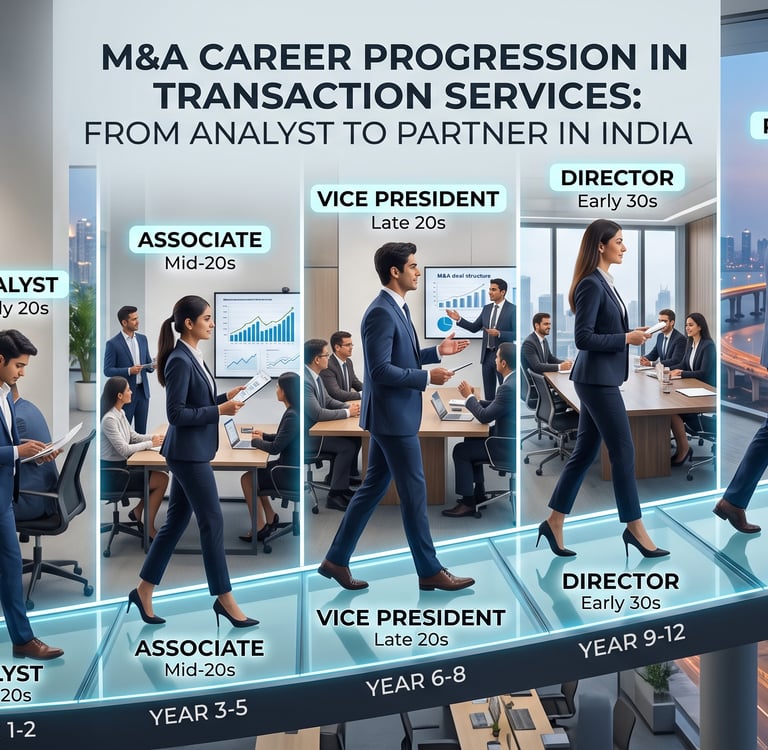
A career in M&A, Transaction Services, or Financial Due Diligence (FDD) is often easy to understand at the beginning.
You join as an Analyst or Associate. You progress to Senior Associate. Then Manager.
Beyond that, the career map becomes less clear.
The timelines vary. The skills that drive promotion change substantially. And the choices you make about sector specialisation, client relationships, leadership, and business development begin to matter more than technical ability alone.
So, what does the full M&A career progression in Transaction Services in India actually look like?
Here is the career map from Analyst to Partner.
Analyst and Senior Associate: Years 0–4
Build the Technical Foundation
The early years of a Transaction Services career are about technical depth and deal exposure.
You are typically working on:
Financial statement analysis
Quality of Earnings (QoE)
EBITDA adjustments
Revenue and margin trends
Net working capital
Net debt and debt-like items
Customer concentration
Databooks and FDD reports
At this stage, deal volume and variety matter enormously. Working across different sectors, business models, and transaction types helps build commercial judgment faster.
The professionals who progress quickly do more than build schedules. They begin asking better questions:
Why did EBITDA move?
Is the margin improvement sustainable?
Would a buyer accept this adjustment?
What is the real deal implication?
That shift from analysing numbers to interpreting a business—is the foundation of a strong Financial Due Diligence career.
What accelerates progression?
Volunteer for complex workstreams. Take ownership of report sections, not just Excel schedules. Learn to communicate findings clearly. Build relationships with Managers and senior team members who can advocate for your progression.
Common mistake
Becoming technically strong but commercially narrow.
A good Analyst produces accurate analysis. A future Manager understands why that analysis matters to the deal.
Manager: Years 4–7
Move From Execution to Ownership
The Manager promotion is the first major inflection point in a Transaction Advisory career path.
Technical excellence is still important but no longer enough.
You are now expected to:
Own the FDD deliverable
Manage the deal team
Review analysis efficiently
Lead management discussions
Identify key deal issues
Manage client communication
Deliver under tight timelines
The question changes from:
“Can you do the analysis?”
to:
“Can we trust you to own the deal?”
The Managers who progress fastest usually build a reputation for three things: reliable delivery, strong team leadership, and sound commercial judgment.
They also begin developing sector expertise. Over time, they become the natural choice for a particular type of transaction whether technology, healthcare, consumer, industrials, or private equity deals.
Why do some professionals plateau at Manager?
Because they remain strong individual contributors but never fully transition into team leadership.
If you still need to personally rebuild every schedule and solve every problem, you may be demonstrating technical strength—but not scalability.
At Manager level, progression depends on your ability to create quality through a team.
Senior Manager: Years 7–12
Make the Business Development Turn
Senior Manager is where an M&A career becomes commercially entrepreneurial.
By now, strong deal execution is expected.
The next question is:
Can you help create opportunities, not just execute them?
Senior Managers increasingly build relationships with:
Private equity funds
Investment bankers
M&A lawyers
Corporate development teams
Founders and CFOs
This is often the hardest transition for professionals who built their careers on analytical excellence.
Business development requires a different skill set: relationship maintenance, market positioning, sector credibility, concise communication, and the patience to cultivate relationships over years.
The Senior Managers who progress toward Director and Partner are usually those who can develop client relationships independently not only manage relationships created by someone else.
Common mistake
Waiting until Director level to start building a network.
By then, you may already be behind.
Director and Partner
Build a Practice, Not Just a Career
At Director and Partner level, the role changes fundamentally.
You are no longer primarily responsible for executing deals. You are responsible for building and leading a business.
That means:
Managing strategic client relationships
Originating new engagements
Developing sector positioning
Building senior teams
Growing revenue
Leading major pitches
Developing future leaders
Making decisions about where the practice should invest
The analytical skills that drove your early career are still valuable—but they now support a much broader set of responsibilities.
At this stage, successful professionals usually become known for something:
Technology FDD. Healthcare transactions. Private equity. Sell-side diligence. Cross-border deals. Carve-outs. Mid-market M&A.
Generic competence becomes less powerful at senior levels. A clear market identity matters.
The strongest Partners combine three qualities:
Technical credibility. Commercial conviction. Leadership.
They understand the work deeply enough to challenge conclusions. They build relationships that generate opportunities. And they create teams that strong professionals want to remain part of.
How Long Does It Take to Become a Partner in Transaction Advisory?
There is no universal timeline, but a broad Transaction Services career progression in India may look like this:
Career Level Indicative Experience Primary Focus
Analyst / Associate 0–2 years Technical analysis
Senior Associate 2–4 years Independent execution
Manager 4–7 years Deal ownership
Senior Manager 7–12 years Client relationships and BD
Director 10–15+ years Market positioning and growth
Partner 12–20+ years Origination and practice building
These timelines vary significantly across Big 4 Transaction Advisory teams, specialist M&A firms, and boutique advisory practices.
What matters more than title is whether your capabilities are evolving ahead of your role.
The Skills That Matter at Each Career Stage
One of the biggest mistakes in an FDD career is continuing to optimise for the skills that earned your previous promotion.
The career progression is roughly:
Analyst: Technical accuracy and curiosity
Senior Associate: Independent execution and communication
Manager: Ownership and team leadership
Senior Manager: Client relationships and business development
Director: Market positioning and commercial growth
Partner: Origination and practice building
The skills that make you an excellent Analyst will not automatically make you a strong Manager.
The skills that make you a strong Manager will not automatically make you a Director.
And technical excellence alone rarely builds a path to Partner.
Is Transaction Advisory a Good Career in India?
For finance professionals who enjoy the intersection of accounting, analytics, business strategy, and live transactions, Transaction Advisory and Financial Due Diligence can offer a strong long-term career path.
It is particularly relevant for:
Chartered Accountants
Audit professionals
Finance analysts
MBA graduates
Professionals moving into M&A advisory
Big 4 aspirants
The career can also open opportunities in private equity, corporate development, investment banking, specialist M&A advisory, and strategic finance roles.
But the profession is demanding. Deal timelines are unpredictable, expectations rise quickly, and senior progression requires far more than technical competence.
The professionals who build durable careers are those who evolve before the next promotion forces them to.
The Career Map Nobody Draws for You
The full M&A career progression in Transaction Services can be summarised simply:
Analyst: Learn to analyse.
Senior Associate: Learn to execute.
Manager: Learn to own.
Senior Manager: Learn to build relationships.
Director: Learn to create a market position.
Partner: Learn to build a business.
The biggest career mistake is continuing to optimise for the skills that earned your previous promotion.
A successful long-term career in M&A, Financial Due Diligence, and Transaction Advisory Services requires continuous reinvention from analyst to advisor, from advisor to leader, and from leader to practice builder.
Build the Skills That Accelerate Your FDD Career
If you are a CA, finance professional, auditor, or aspiring deal professional looking to build practical skills in Financial Due Diligence, Quality of Earnings, EBITDA adjustments, working capital, net debt, databook preparation, and M&A deal analysis, explore the Investyn FDD Masterclass.
Build practical, deal-focused capabilities that can help accelerate your transition into Transaction Services and M&A advisory.

Get in Touch
Phone
+91-9877358600
investynadvisors@gmail.com
Important links
D9, Omicron 1A, Greater Noida - 201310