Disclaimer: Investyn Advisors is an educational platform and does not provide investment advice, stock tips, buy/sell recommendations, portfolio management, or any investment advisory services. All content is intended solely for educational and informational purposes and should not be construed as financial or investment advice.

How to Build Your FDD Skills Without Being on a Deal Team
You cannot learn FDD by reading textbooks. But you also cannot wait for a deal team invite before you start building real skills. Here are the specific methods that actually work—used by professionals who made it into TS.
FDD M&AFDD
6/15/20263 min read
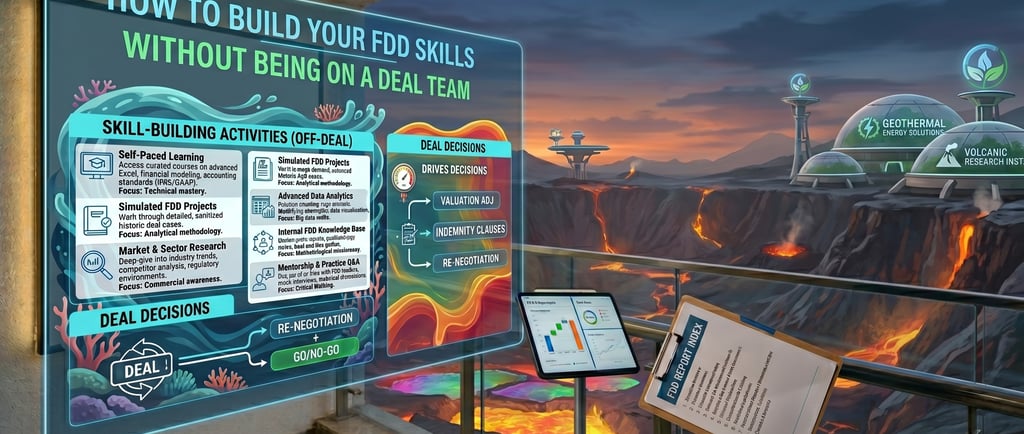

The Catch-22 of FDD Experience
Almost every TS hiring manager wants candidates with deal experience. And almost every finance professional trying to break into TS does not yet have deal experience. This is the classic catch-22 of M&A careers.
But the catch-22 is not as absolute as it appears. There is genuine, substantive FDD skill development you can do before you ever sit in a data room and the candidates who have done this preparation are immediately distinguishable in interviews from those who have not.
Here are the specific methods that work.
Method 1: Read Financial Statements Like an FDD Professional
Every listed company in India publishes quarterly and annual financial statements. This is an enormous, free, constantly refreshed dataset for FDD skill development.
The exercise: take a set of annual reports from an Indian listed company ideally one you find commercially interesting and analyse them as if you were conducting FDD. What normalisation adjustments might you make to the reported EBITDA? What revenue quality risks do you see? How does working capital move across the year? What does the auditor's note say, and does it raise any flags?
Start with industries you know well. FMCG, banking, IT services, and pharmaceuticals all have publicly available management accounts, segment reporting, and detailed financial disclosures. A two-year trend analysis of any mid-cap Indian company will surface the same types of analytical questions that appear in a real FDD engagement.
Do this consistently for three to six months and you will develop the pattern recognition that distinguishes a trained FDD eye from a general finance reader.
Method 2: Build a Practice Databook
The FDD databook is the analytical workhorse of every engagement. Building one from scratch—even from publicly available data is one of the best ways to develop the Excel and structural skills that TS teams test for.
Take a company's publicly available financial data and build a simplified FDD databook: a historical P&L with monthly granularity (estimated from quarterly data where necessary), a working capital schedule, an EBITDA bridge with normalisation adjustments, and a preliminary net debt schedule.
The process of building this—deciding on tab structure, building reconciliation checks, formatting the output professionally, and documenting your assumptions—is precisely what you will do on a live deal. Do it ten times before your first interview and you will be better prepared than most candidates.
Method 3: Engage Seriously with Deal Coverage
The Indian M&A market generates deal coverage across multiple publications Economic Times, Mint, VCCircle, Mergermarket, and the deal announcements published by PE funds and advisory firms directly.
Make it a habit to read deal announcements critically: What sector? What deal size? Who are the advisors? What was the reported valuation multiple? What strategic rationale did the buyer cite?
Over time, you build a mental library of deal context what sectors are active, what multiples are paid in which industries, which advisory firms are most active in which deal types. This commercial awareness is directly tested in senior TS interviews and is genuinely difficult to fake.
Method 4: Structured Training Through Practitioner-Led Programmes
Textbooks and academic courses on M&A are largely useless for FDD skill development because they teach theory without deal context. The Ind AS curriculum does not teach you to normalise EBITDA. A CFA study guide does not teach you to structure a working capital peg.
The most effective structured training for FDD is delivered by practising professionals who use live deal case studies not hypothetical examples, but anonymised real deal scenarios with real data quality issues, real normalisation judgment calls, and real report structures.
This is the design principle behind the Investyn FDD Masterclass: every module is built from deal experience, not from a curriculum. The goal is not to teach you what FDD is it is to teach you how to do it.

Get in Touch
Phone
+91-9877358600
investynadvisors@gmail.com
Important links
D9, Omicron 1A, Greater Noida - 201310