Disclaimer: Investyn Advisors is an educational platform and does not provide investment advice, stock tips, buy/sell recommendations, portfolio management, or any investment advisory services. All content is intended solely for educational and informational purposes and should not be construed as financial or investment advice.
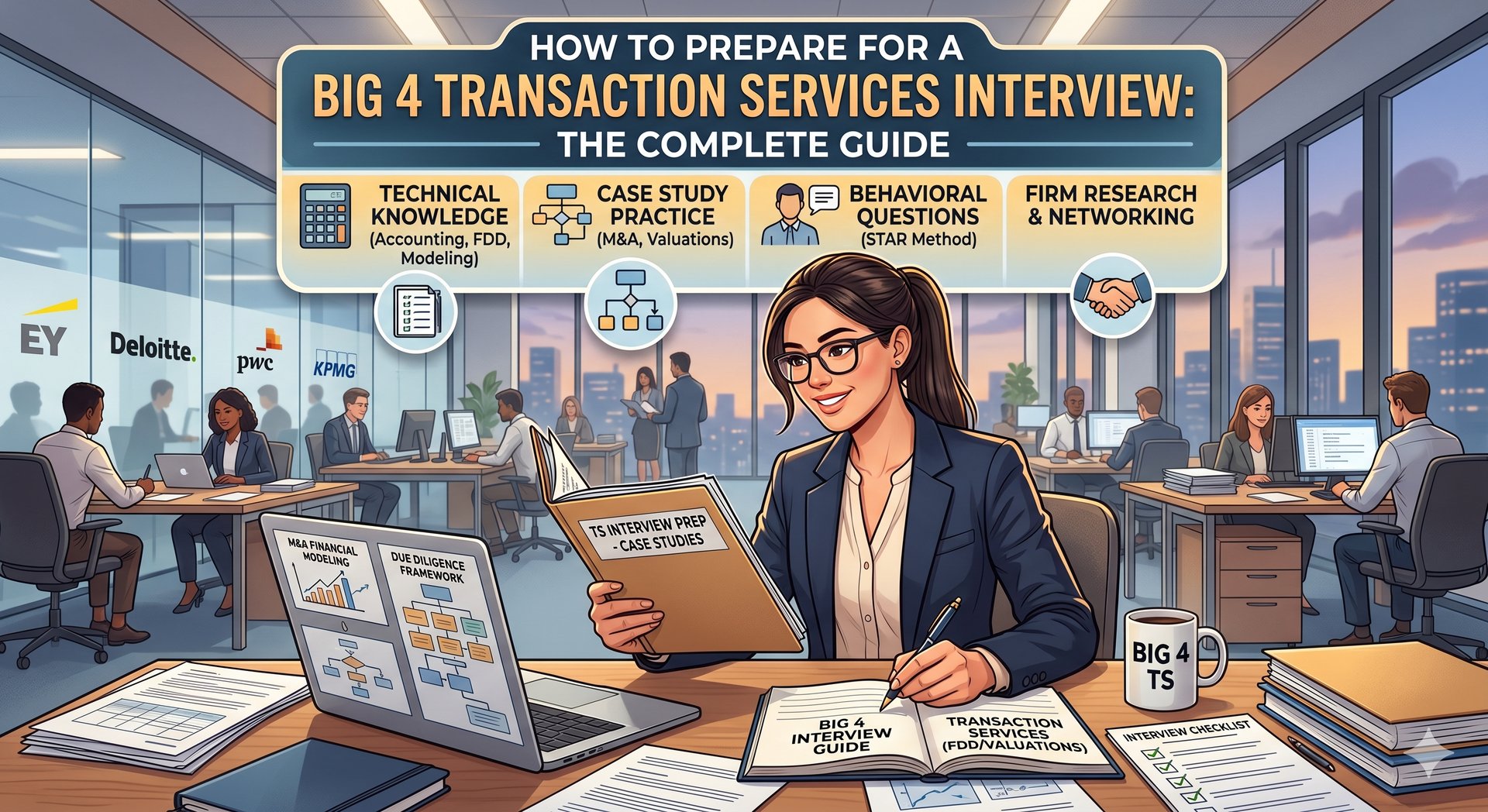
How to Prepare for a Big 4 Transaction Services Interview: The Complete Guide
Big 4 TS interviews have a distinct structure—technical, case study, and cultural rounds—each testing specific capabilities. This is the complete preparation guide, written by someone who has designed and conducted these interviews.
FDD M&AFDD
6/12/20263 min read
What Big 4 TS Teams Are Actually Testing
The Big 4 transaction services interview process is more structured and more technically demanding than most candidates expect. Each round tests a specific dimension of fit, and a strong performance in one round does not compensate for a weak one in another.
Understanding what each round tests and preparing specifically for each is the most efficient approach to Big 4 TS interview preparation. Here is the complete guide.
Round 1: The Technical Screening
The first round is typically conducted by a Manager or Senior Associate and focuses exclusively on technical knowledge. Expect questions on FDD concepts (QoE, EBITDA normalisation, working capital mechanics, debt-like items), accounting standards relevant to deal work (Ind AS 115, 116), and general M&A mechanics.
Preparation: The content of this guide's companion articles covers the core FDD concepts you will need. The Deal Fluency FDD Masterclass provides live deal case studies that make these concepts intuitive rather than just definitional.
Do not memorise definitions. Understand the concepts well enough to apply them in a conversation. The interviewer can tell within two minutes whether your knowledge is rote or genuine.
Round 2: The Case Study or Analytical Exercise
Many Big 4 TS practices include a case study round—either a take-home exercise or a timed in-interview exercise. You will be given a data set (often simplified management accounts and a P&L) and asked to: identify key trends and anomalies, calculate a normalised EBITDA, structure a preliminary information request list, or flag key diligence issues for a buyer.
Preparation: Practice with real financial data. Take the annual reports of Indian listed companies and attempt to identify normalisation candidates, revenue quality risks, and working capital anomalies. The exercise is not about arriving at a "right answer" it is about demonstrating structured thinking and professional judgment.
Be prepared to talk through your analysis out loud. The interviewer wants to understand your reasoning process as much as your conclusions.
Round 3: The Partner or Senior Manager Round
This round tests fit, commercial awareness, and communication quality. Technical knowledge is assumed at this stage. The senior interviewer is assessing: whether you can hold a professional conversation with a CFO-level counterpart, whether your understanding of the market and the firm's practice is credible, and whether your interest in TS is genuine and well-reasoned.
Preparation: Research the firm's recent deal announcements and sector focus. Know the key PE transactions in India in the past twelve months. Prepare a specific, well-reasoned answer for "Why transaction services?" that does not sound like a generic career objective. And prepare thoughtful questions to ask the interviewer—not about compensation, but about deal team culture, recent engagements, and the firm's M&A market focus.
The Mistakes That Kill Otherwise Strong Applications
Based on my experience on both sides of this process, here are the most common reasons strong candidates do not get offers:
Insufficient deal-specific knowledge: Generic accounting knowledge is table stakes. Candidates who cannot discuss QoE, EBITDA normalisation, or working capital mechanics fluently are screened out at the technical round.
Inability to communicate findings clearly: In the case study round, candidates who produce technically sound analysis but cannot explain it in professional, concise language underperform.
Unconvincing motivation: Partners are experienced at identifying candidates who are applying to TS as a fallback from investment banking, or because they want "something better than audit" without a clear sense of what TS actually involves. Be able to articulate your reason for choosing TS specifically and credibly.
Poor market awareness: Not knowing who the major PE funds in India are, which sectors are most active in M&A, or what your target firm's recent deal activity looks like signals insufficient preparation and insufficient genuine interest.

Get in Touch
Phone
+91-9877358600
investynadvisors@gmail.com
Important links
D9, Omicron 1A, Greater Noida - 201310