Disclaimer: Investyn Advisors is an educational platform and does not provide investment advice, stock tips, buy/sell recommendations, portfolio management, or any investment advisory services. All content is intended solely for educational and informational purposes and should not be construed as financial or investment advice.

The FDD Report: What It Looks Like, What's in It, and How It Drives Deal Decisions
What does a Financial Due Diligence report actually contain? A practitioner's guide to the structure, content, and commercial impact of the FDD report the most important document in any M&A transaction.
FDD M&AFDD
6/15/20263 min read

The Document That Can Make or Break a Deal
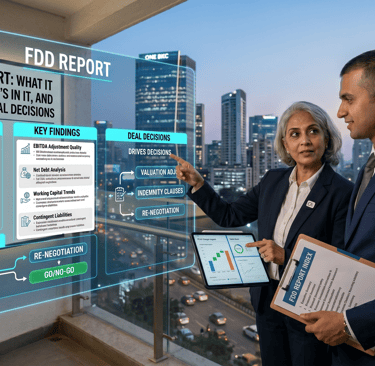
The FDD report is the primary deliverable of a financial due diligence engagement. It is the document that a PE fund's investment committee reads before approving a deal. It is the basis for the buyer's lawyers drafting the representation and warranty clauses in the SPA. It is the evidence base that determines whether the deal proceeds at the agreed price, is repriced, or falls apart.
Understanding the structure and content of a professional FDD report is essential for anyone who works in or around M&A whether you are producing it, commissioning it, or responding to the questions it raises.
Section 1: Executive Summary
The executive summary is the most-read section of any FDD report and typically runs two to four pages. It distills the findings of the entire engagement into a format that a busy investment committee can read in fifteen minutes and come away with a clear view of the deal's financial risks and opportunities.
A professional executive summary includes: a concise overview of the business and deal context; a summary of the adjusted EBITDA and the key normalisation adjustments; the net debt position and the most significant debt-like items identified; the working capital assessment and any peg considerations; the top three to five financial diligence risks, clearly articulated and quantified; and a brief commentary on financial projections credibility.
What separates a strong executive summary from a weak one: the findings are specific and quantified, not vague and hedged. Every key finding has a number and a source. The commercial implications of each finding are stated explicitly.
Section 2: Quality of Earnings
The QoE section is typically the longest in the report and forms its analytical backbone. It presents the EBITDA bridge a waterfall from reported EBITDA through management adjustments, FDD adjustments, and any additional normalisation items to an adjusted, LTM EBITDA.
For each normalisation adjustment, the report explains: what the item is, why it has been included or excluded, the quantum of the adjustment, and the evidence base supporting it.
This section also includes a revenue analysis (by customer, product, geography, and contract type), a cost analysis (identifying any above or below market costs, related-party transactions, or one-off expense items), and a commentary on the reliability of management accounts versus statutory financials.
Section 3: Net Debt and Debt-Like Items
This section presents the full net debt position financial debt less cash and cash equivalents and, critically, the debt-like items that adjust the equity price at closing.
Each debt-like item is identified, quantified, and sourced. The most commonly contested items in this section are: deferred revenue (particularly in subscription or SaaS businesses), pension obligations (particularly in legacy manufacturing businesses), and committed capex or lease obligations that have not been reflected in the market valuation.
A well-prepared net debt section saves significant time and legal cost in the SPA negotiation, because the buyer and seller have a shared, evidence-based reference point for what constitutes net debt versus working capital.
Section 4: Working Capital Analysis
The working capital section establishes the recommended peg level the normal working capital that the seller should deliver at closing and explains the methodology used to arrive at it.
This involves presenting monthly working capital data over at least twelve months, identifying seasonal patterns, and excluding any items that are not genuinely operational working capital. The section also flags any trends in working capital that might indicate cash management strategies ahead of a sale such as a deliberate reduction in creditor days that flatters the cash position but creates a working capital shortfall at closing.
Section 5: Financial Projections Review
Most FDD reports include a section on management's financial projections the revenue and EBITDA forecasts that underpin the seller's valuation case. The FDD team does not formally opine on the commercial assumptions driving those projections (that is the CDD team's territory), but they do assess: whether the projections are consistent with historical performance, whether the cost assumptions are realistic given actual cost run rates, and whether there are any financial model errors or inconsistencies.
This section is often the most commercially sensitive in the report. Sellers who have built aggressive projections into their valuation model are anxious about FDD commentary that highlights the distance between historical performance and projected growth.
How the Report Drives Deal Decisions
The FDD report drives deal decisions in three primary ways.
Valuation adjustment: If the adjusted EBITDA is materially below the seller's claimed EBITDA, the buyer reprices either by applying the same multiple to a lower EBITDA, or by demanding a discount to reflect the risk identified.
Deal structure adjustment: Significant findings customer concentration, revenue quality risks, or material debt-like items often result in deal structure changes: price retention clauses, earn-outs tied to post-closing performance, or enhanced representations and warranties in the SPA.
Deal termination: In severe cases, where the FDD findings reveal fundamental misrepresentation or financial risks that cannot be priced or mitigated, the buyer may exercise their right to walk away. This is relatively uncommon, but it is a real outcome and it is one of the most important functions of a rigorous FDD process.

Get in Touch
Phone
+91-9877358600
investynadvisors@gmail.com
Important links
D9, Omicron 1A, Greater Noida - 201310